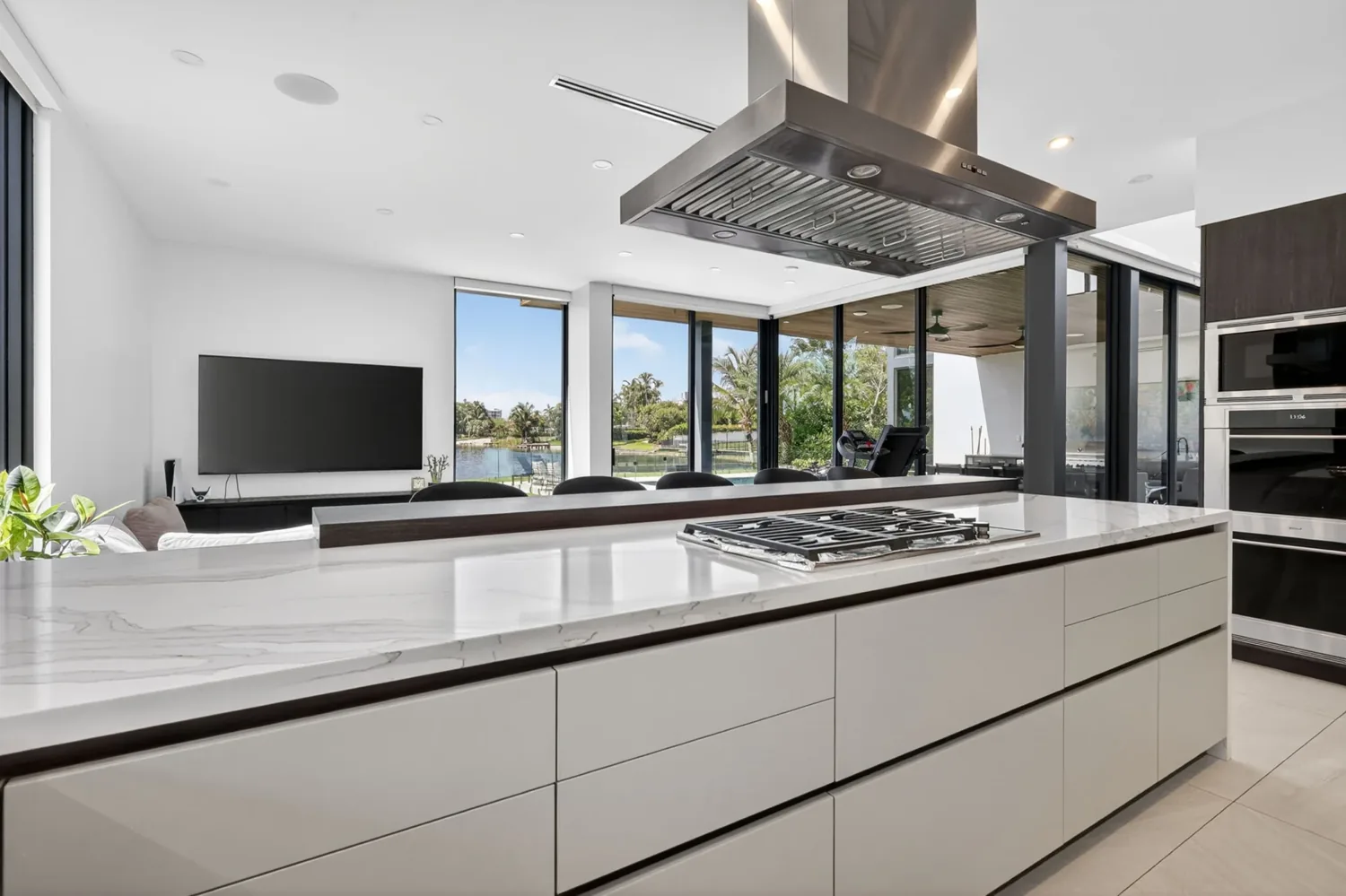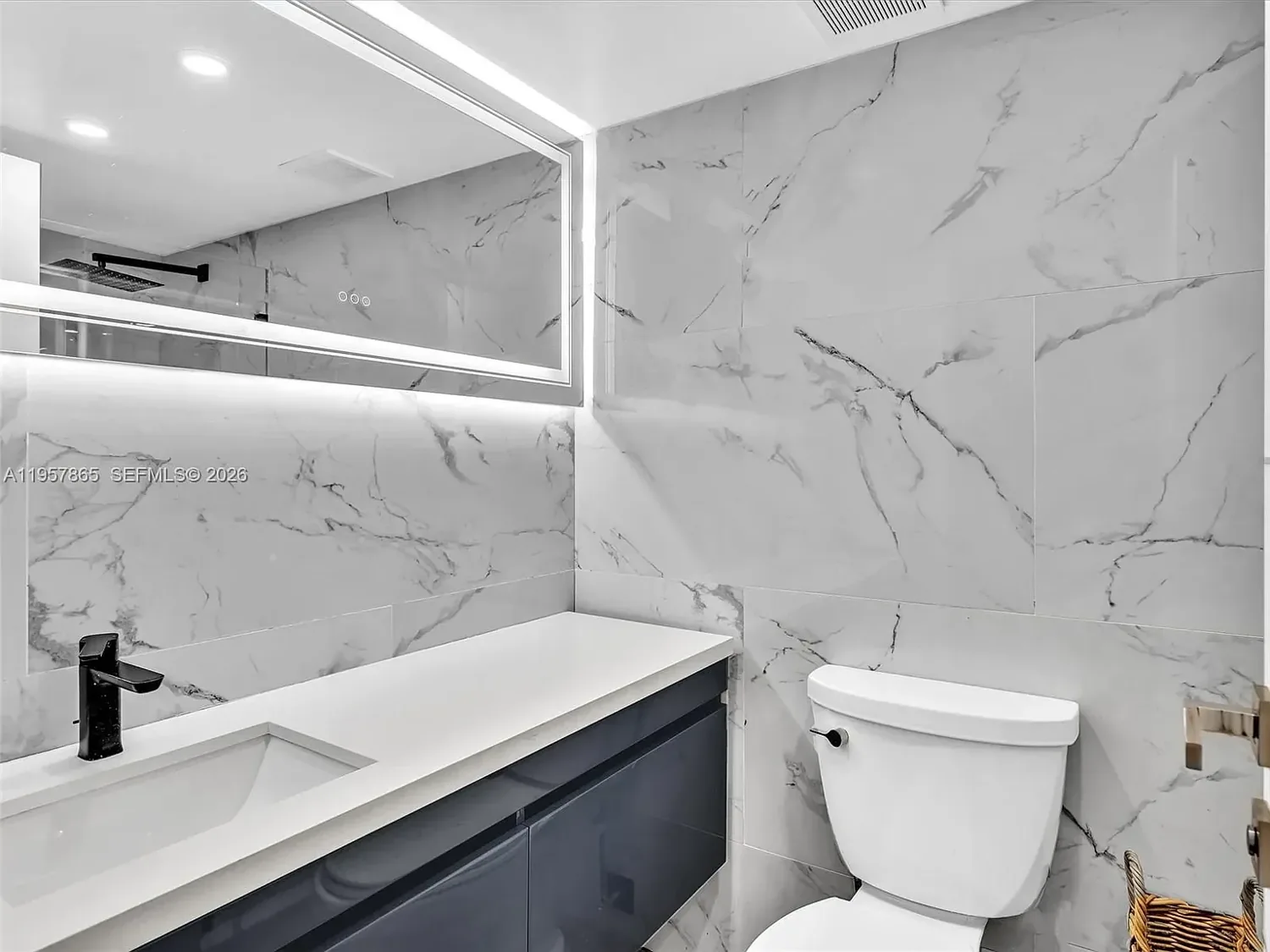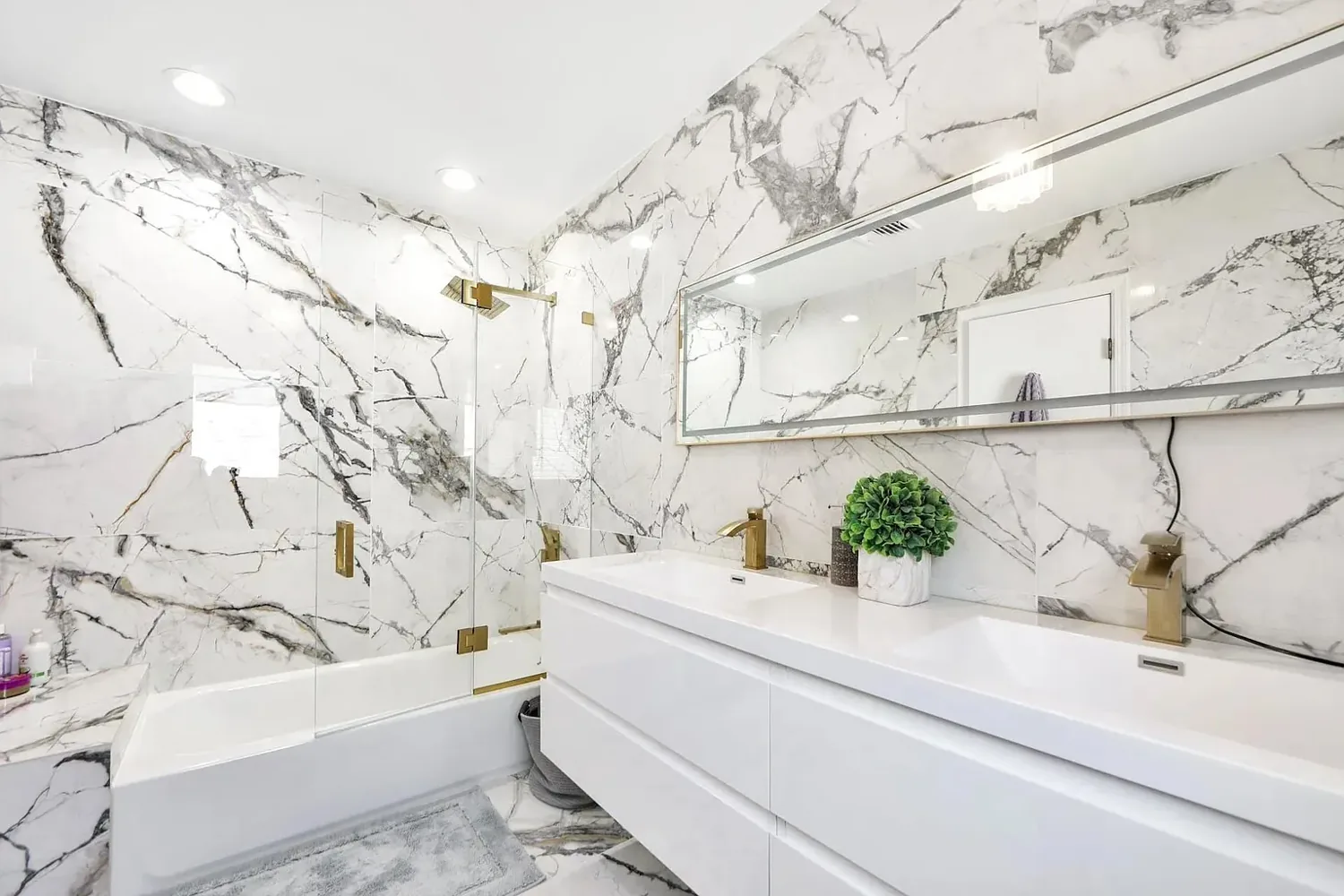
Stock cabinets are pre-built in fixed sizes and typically cost about $150–400 per linear foot installed; semi-custom cabinets are built to order from a catalog with more sizes and finishes, at roughly $400–700; custom cabinets are made for your room and usually run $500–1,200. In Florida, the box material matters as much as the tier. A plywood sink base survives a slow leak that would ruin a particleboard one, and the best-looking doors in the catalog will not save a box that swells.
Here is how the three tiers differ in construction, how they hold up in South Florida humidity, how long they take, and where the money actually goes.
What is the difference between stock, semi-custom and custom cabinets?
Stock cabinets are manufactured in advance in standard widths, usually in 3-inch increments, in a limited range of door styles and finishes. Big-box stores and flat-pack brands sell them. You design the kitchen around the boxes, and filler strips close the gaps between the last cabinet and the wall.
Semi-custom cabinets start from a manufacturer’s catalog but are built after you order. You get more widths, depth modifications, more door styles and paint colors, and better interior options such as drawer organizers, roll-outs and taller uppers. Most mid-to-upper range kitchens in South Florida use this tier.
Custom cabinets are built for one specific room by a cabinet shop or a high-end manufacturer. Any size, any profile, any species, panels to match appliances, and tolerances fitted to walls that are never quite straight. This is the tier for a kitchen designed around an unusual space, built-in millwork that continues into living areas, or a design that a catalog simply does not offer.
How much do cabinets cost per linear foot?
We cross-checked current cost data from two independent sources. They are close, and both are national figures.
| Tier | Typical installed cost per linear foot | Best for |
|---|---|---|
| Stock | $150–400 | Rentals, budget refreshes, laundry rooms, garages |
| Semi-custom | $400–700 | Most full kitchen remodels |
| Custom | $500–1,200; designer millwork priced after design | High-end kitchens, odd spaces, integrated millwork |
Installation labor alone is commonly quoted at about $75–150 per linear foot for semi-custom and $200–300 for custom, because custom work involves more scribing, leveling and fitting on site. Scribing cabinetry to out-of-square walls and tying it into integrated millwork is fussy, technical work, and it is where we do our best work. The overlap between tiers is large: a well-specified semi-custom line can cost more than a basic custom shop. In our experience cabinetry is typically the largest single line item in a kitchen, which is why it deserves the most attention in the budget. For the full picture, see kitchen remodel cost in Miami.
Plywood vs particleboard: what the box is made of
Doors are what you see. The box is what lasts. Cabinet boxes are usually made from one of three materials:
- Particleboard is wood particles bonded with resin, typically covered with melamine or laminate. It is flat, stable and inexpensive. Its weakness is water: once moisture gets past the finish at a raw edge or a screw hole, it swells and does not recover.
- MDF (medium-density fiberboard) is finer and smoother than particleboard and is excellent for painted doors and panels. It shares the same weakness with standing water.
- Plywood is cross-laminated veneers. It holds screws better, is lighter for its strength, and tolerates incidental moisture much better. It costs more.
Many good cabinet lines mix them: plywood boxes with MDF doors for paint, or plywood sink bases with particleboard elsewhere. That is a reasonable choice. What we push back on is particleboard under the sink, behind the dishwasher, and beside the refrigerator water line, because those are where leaks happen.
Ask for the construction sheet, not the brochure. It will state box material and thickness, back panel thickness, drawer box construction (dovetailed solid wood, plywood or stapled particleboard), and hardware. Third-party certification from the Kitchen Cabinet Manufacturers Association (KCMA), which tests structural strength, door and drawer integrity and finish durability, is another useful signal. KCMA says certification is available at every price point.
How cabinets perform in Florida humidity
South Florida is hard on cabinets in specific ways. Houses that sit closed while owners travel can run humid inside if the air conditioning is set too high or switched off. Beachfront condos get salt air. And slab-on-grade houses put base cabinets close to the floor, where a minor plumbing leak can sit unnoticed.
What actually helps:
- Plywood in wet zones. Sink base, dishwasher side panels, and anywhere near ice-maker and water lines.
- Fully finished interiors and edges. Moisture enters through unsealed edges and cutouts. Good manufacturers seal them; ask whether plumbing cutouts made on site are sealed afterward.
- Raised or sealed toe kicks. The bottom edge is the first part to see mopping water and leaks.
- Painted finishes that suit the climate. Painted MDF doors are fine in conditioned space. Solid wood doors move more with humidity, and painted solid wood can show hairline cracks at joints. Many shops use MDF center panels for that reason.
- Hardware. Near the water, stainless or coated hardware avoids corrosion.
- Keep the AC running. If you leave for the summer, set the thermostat and a humidity limit rather than turning it off. That protects cabinets, floors and drywall alike.
Outdoor kitchens are a separate category entirely. Indoor cabinets of any tier, including custom, are not designed for an exterior terrace. Use cabinetry built for exterior use.
Lead times: the schedule question
Stock cabinets are the fastest, often available within days if the store has them in stock, though popular finishes can be back-ordered. Semi-custom lines are built to order, so they take weeks from final approval. Custom work takes the longest, because it involves shop drawings, approvals, finishing and sometimes sample doors before production starts.
Two things matter more than the quoted lead time. First, the clock starts at signed shop drawings and deposit, not at the first meeting. Second, final measurements must be taken after framing and drywall are done, so a custom order cannot be placed on day one of a renovation. We plan for this in the schedule; our kitchen remodel timeline article shows where cabinets fall in the sequence, and how long a renovation takes covers the broader picture.
Where it is worth spending
- Spend on boxes and drawers. Plywood construction, full-extension soft-close drawers and good hinges are what you notice every day for 20 years.
- Spend on the layout, not the door. A semi-custom kitchen with the right drawer sizes and a well-planned pantry will outperform a custom kitchen with a bad layout.
- Save on secondary rooms. Laundry, garage and utility areas can use stock cabinets with no real loss.
- Go custom when the room demands it. Ceilings over 10 feet, curved or out-of-square walls, integrated appliances, or millwork that continues into living spaces are where a catalog runs out.
On the Bay Harbor apartment, where 26 Builders also did the interior design, the cabinetry was planned with the rest of the apartment rather than picked from a catalog afterward. That is the advantage of treating cabinets as part of the design, not a product purchased separately. You can see more finished work in our kitchen gallery and on our kitchen remodeling page.
A real cabinet number depends on your layout, linear footage, box construction and finish, which takes measuring the room and a design. That starts with a site visit.
Frequently asked questions
Are semi-custom cabinets worth the extra cost over stock?
For a primary kitchen, usually yes. Semi-custom lines offer more sizes, which means fewer filler strips and better use of space, plus better drawer and interior options and more finishes. Many also offer plywood box upgrades. For laundry rooms, garages and rentals, stock cabinets are often perfectly adequate.
Is plywood really better than particleboard for cabinets?
For moisture, yes. Particleboard swells permanently once water gets in through an edge or hole, while plywood tolerates incidental moisture much better and holds screws more securely. Particleboard is flat and stable when dry. A sensible compromise is plywood for the sink base and wet areas, even if the rest of the kitchen is particleboard.
How long do custom cabinets take?
Custom cabinets take the longest of the three tiers because they involve shop drawings, approvals and finishing before and during production. The timeline starts when drawings are signed and the deposit is paid, and final measurements need to wait until walls are closed. Ask each shop for a written lead time from approval to delivery.
What cabinets hold up best in Florida humidity?
Cabinets with plywood boxes, fully sealed edges and interiors, and quality finishes perform best. Painted MDF doors hold up well in air-conditioned homes. The most important factors are keeping water away from raw edges and keeping the AC running when the house is empty. Indoor cabinets of any tier should not be used outdoors.
What is KCMA certification?
The Kitchen Cabinet Manufacturers Association runs a third-party certification program that tests cabinets for structural strength, door and drawer integrity and finish durability. It is available at every price point, so it is a useful way to compare lines objectively. It is not a substitute for checking box material and construction yourself.