Replacing a tub with a walk-in shower is usually the right call for a primary bathroom in South Florida, and usually the wrong call if it removes the last tub in a house that families will want to buy. Our rule of thumb: keep at least one bathtub in any house with children’s bedrooms, and convert the primary bath to a large walk-in shower if that is how you live. In condos aimed at downsizers and retirees, the tub matters far less, and a well-built, low-threshold shower is often a selling point.
The decision is part resale, part space and part construction. Here is how we think it through with clients.
Does removing a bathtub hurt resale value?
It depends on who buys your house next, and in South Florida that depends heavily on what kind of property it is.
Single-family homes in family neighborhoods. Buyers with young children want a tub, because bathing a toddler in a shower is a daily problem, not a design preference. If your house has three or four bedrooms and the only tub has been replaced with a shower, some of those buyers will either walk away or start pricing a bathroom renovation into their offer. That is the scenario to avoid.
Condos on the beach and the Intracoastal. In buildings across Aventura, Sunny Isles Beach, Hallandale Beach and Bal Harbour, many buyers are downsizers, second-home owners and retirees. For many of them, stepping over a tub wall is the problem, and a generous walk-in shower is what they are looking for. Removing the tub in a one- or two-bedroom condo rarely costs you a buyer, and in many cases it helps.
Luxury homes. At the top of the market, the primary bath we are most often asked for has a large shower and a freestanding soaking tub, sometimes in the same wet zone. Here the tub is more about the image of the bathroom than about bathing children, and the answer is often both.
The “at least one tub” rule of thumb
You will hear real estate agents say that every house should keep at least one bathtub. We looked for hard data proving the resale effect and did not find a study we would stand behind, so treat this as experienced judgment rather than a statistic.
The logic holds up, though. A tub in a secondary bathroom costs very little to keep, and the buyers who need one tend to need it badly. The asymmetry is the point: keeping a tub in the hall bath rarely loses you a buyer, and removing the only one sometimes does.
Our practical version of the rule:
- House with two or more bedrooms besides the primary: keep a tub in the hall or kids’ bath. Convert the primary if you want.
- House where the primary bath has the only tub: think carefully before removing it, or add a tub elsewhere as part of the project.
- Condo, one or two bedrooms: a walk-in shower is usually fine, and often better.
- Planning to stay 10+ years and age in place: your own needs may outweigh resale. Make that choice on purpose.
Space: what a tub footprint can become
A standard 5-foot alcove tub converts naturally into a 5-foot shower. That is a generous shower, and it is the most common conversion we see, because the plumbing wall, the waterproofing zone and the footprint all stay roughly where they were.
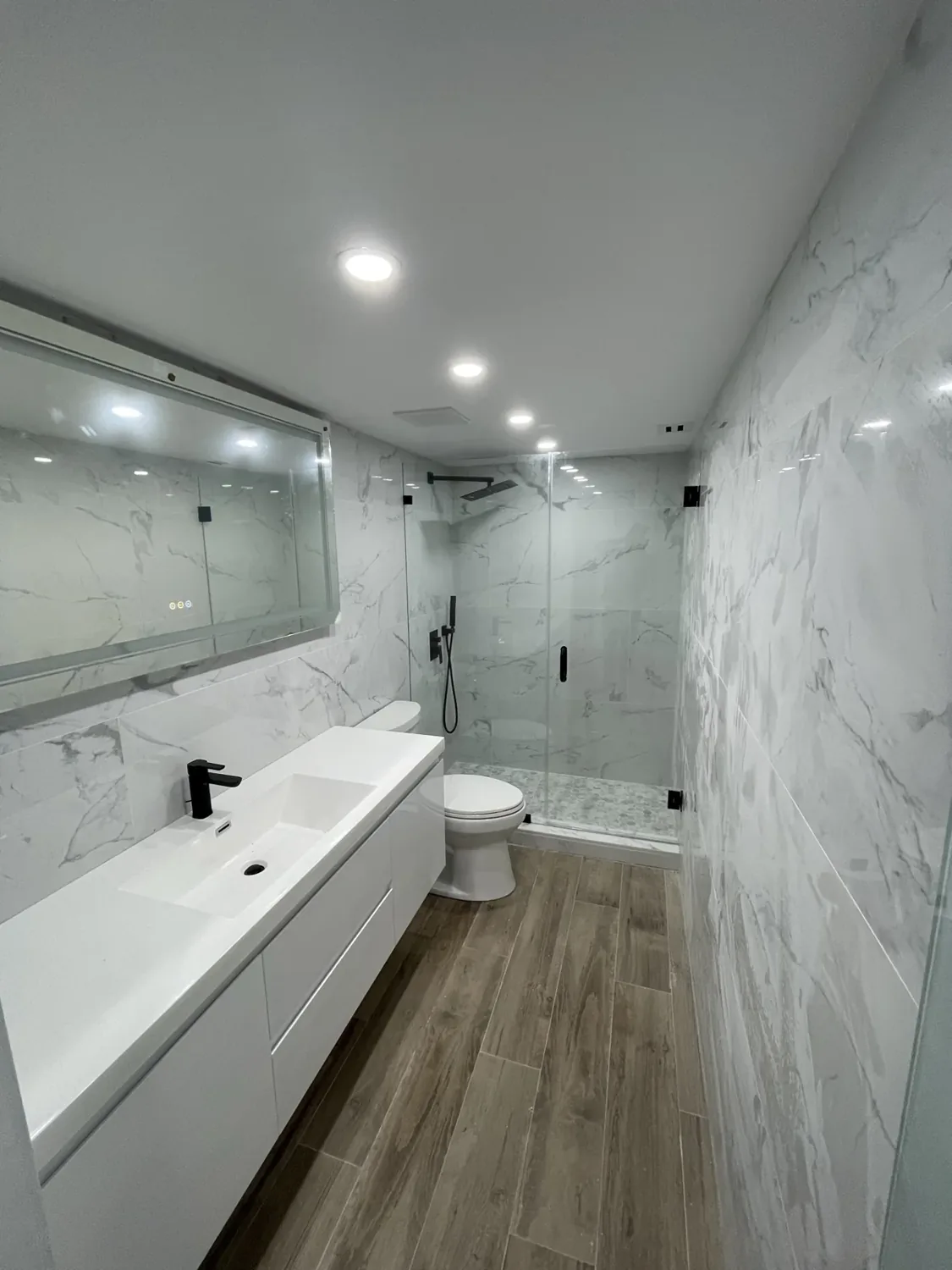
The details are what make it work. A shower that uses the full length of the old tub alcove usually gets a fixed glass panel or a hinged door. A niche goes into the plumbing wall or a framed wall, never into an exterior wall where it would cut into insulation or block. A bench is worth considering for anyone planning to stay in the home as they age.
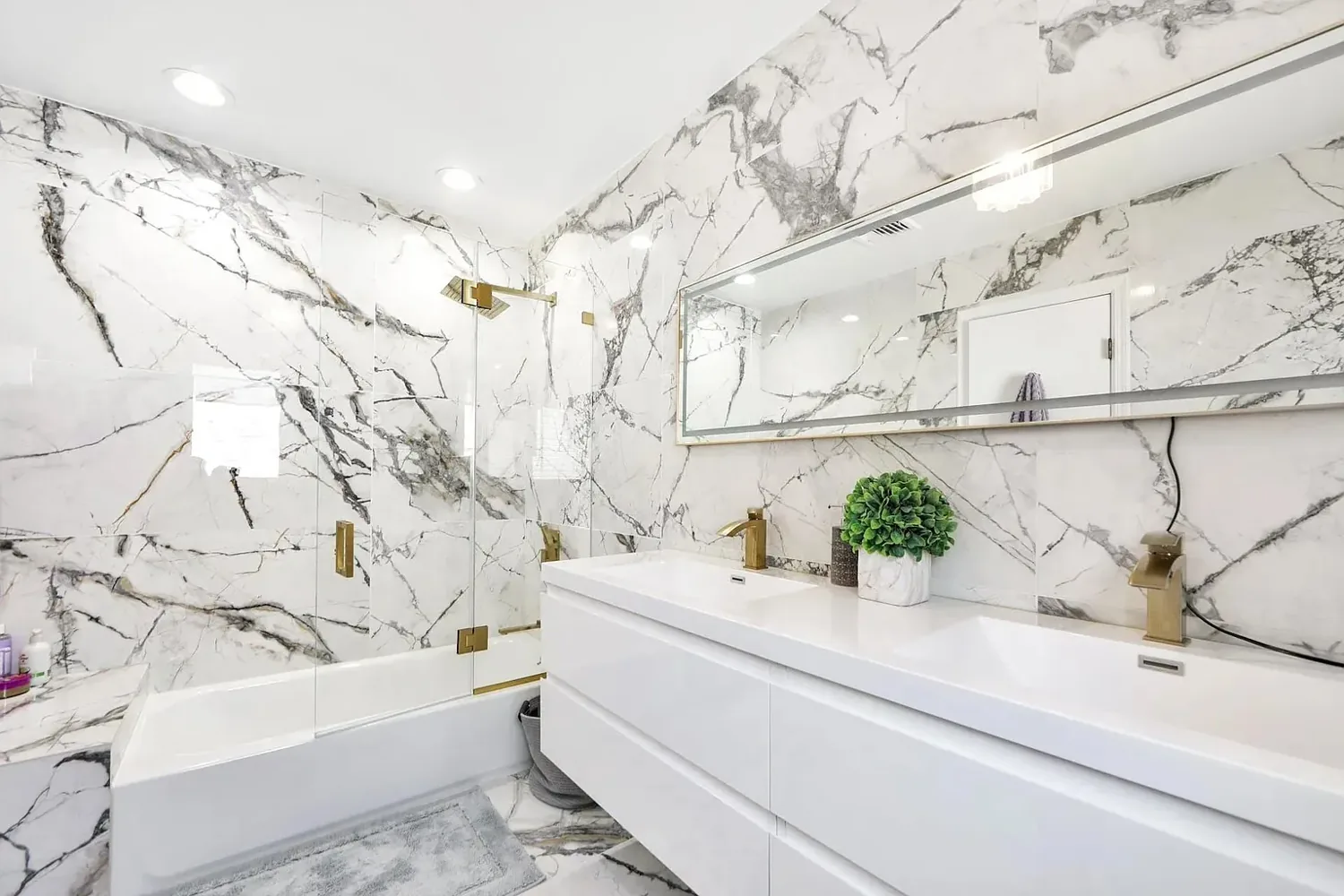
Where the bathroom is larger, there is a different option: a wet room, with the shower and a freestanding tub together behind one glass enclosure. It keeps the tub for resale, gives you the shower you want, and puts all the water in one waterproofed zone. It needs more floor area and more careful drainage design.
Curb or curbless?
A conventional shower has a curb, a raised threshold a few inches high that keeps water in. A curbless shower has the floor slope continuously to a drain, often a linear drain along one wall, so there is nothing to step over. Curbless is better for aging in place and looks cleaner, especially with large-format tile.
Curbless is also a structural question. The shower floor has to sit lower than the bathroom floor to create the slope. In a slab-on-grade house, that usually means cutting and recessing the slab at the shower. In a high-rise condo, cutting the structural slab is often not allowed, so the solution is usually to raise the rest of the bathroom floor or accept a very low threshold. The building’s rules decide what is possible; see condo renovation rules in Miami. We go deeper on this in curbless showers for aging in place.
Waterproofing: where conversions fail
A tub is a waterproof vessel on its own. A tiled shower is not. The tile and stone are the finish; the waterproofing membrane behind and under them is what keeps water out of the walls and the floor. Converting a tub to a shower takes away the vessel and replaces it with a system that has to be built correctly at every corner, the curb, the niche, the valve and the drain.
That is why the most common failure in tub-to-shower conversions is the one nobody sees for a year: a shower pan built without proper slope under the membrane, or a membrane that was treated casually at the corners, leaking slowly into the subfloor. In a condo, that water ends up in the unit below. We explain the full system in bathroom waterproofing in Florida, including flood testing the pan before any tile goes down.
On the Hollywood Lake House, all four bathrooms were rebuilt with waterproofing from the substrate up. That is the standard we apply to every conversion, because the cost difference between doing it right and doing it fast is small compared with the cost of tearing out a finished shower.
Plumbing changes in a conversion
A tub drain sits at one end of the tub. A shower drain can stay near the same spot, but a good shower often wants the drain somewhere else: centered for a square pan, or along the back wall for a linear drain. In a slab house, moving the drain means cutting concrete and re-sloping the drain line, which is routine but adds cost. In an older house, it is also the moment to check what the drain is made of. If it is original cast iron, read our guide to cast iron pipe replacement before you tile over it.
The valve usually changes too. A tub-and-shower valve gives way to a shower valve, often with a handheld on a slide bar, which is far more useful for cleaning and for anyone with limited mobility. Moving or altering plumbing triggers a permit in Miami-Dade, unlike a fixture swap in the same position. Our guide to bathroom remodel permits in Miami-Dade covers what is and is not exempt.
How much does a tub-to-shower conversion cost?
National cost data as of 2026 puts a new walk-in shower installation at about $14,300 on average, and one guide tops custom tiled showers out near $15,000. That describes a tiled shower with a proper membrane, glass and new fixtures. Basic conversions that drop a prefabricated base and surround into the old alcove cost less, but they are a different product.
In South Florida, a fully tiled, properly waterproofed walk-in shower with frameless glass usually lands well above the low national figures, and a curbless shower with a recessed slab or a relocated drain costs more again. Those recessed-slab and relocated-drain jobs are the complicated ones, and they are where we do our best work. What drives the range: prefab versus tiled, tile size and material, glass, whether the drain moves, whether the slab is recessed, the valve and fixture package, and condo building requirements. A real number needs a site visit. For whole-bathroom budgeting, see bathroom remodel costs in Miami, and for how we work, our bathroom remodeling page.
Our recommendation
Decide by the house, not by the trend. In a family home, keep one tub and give yourself the shower you want in the primary bath. In a condo, the walk-in shower usually wins. Wherever you end up, spend the money on the parts you cannot see: slope, membrane, drain and valve. That is what decides whether the shower is still good when you sell.
Frequently asked questions
Should I keep at least one bathtub in my house?
In a single-family home with children’s bedrooms, yes. Families with young children usually want a tub, and removing the only one can cost you buyers or push them to discount their offer. Keeping a tub in a secondary bathroom costs little. In a one- or two-bedroom condo, a tub matters much less to most buyers.
Does a walk-in shower add value to a home?
A well-built walk-in shower in the primary bathroom is attractive to most buyers, particularly downsizers and older buyers in South Florida. Whether it adds value overall depends on what it replaces. Converting the primary bath while keeping a tub elsewhere is generally safe. Removing the only tub in a family house is the case where resale can suffer.
How much does it cost to convert a tub to a shower?
National data as of 2026 puts a new walk-in shower at about $14,300 on average, with custom tiled showers topping out near $15,000 in one guide; prefab conversions cost less. A tiled, properly waterproofed shower with frameless glass in South Florida sits in that range or above it, especially if the drain moves or the slab is recessed for a curbless design. An accurate price needs a site visit.
Can you install a curbless shower in a Miami condo?
Sometimes. A curbless shower needs the shower floor lower than the bathroom floor, and most high-rise buildings do not allow cutting the structural slab. The usual alternatives are raising the rest of the bathroom floor or using a very low threshold. The building’s alteration rules and the board’s approval decide what is possible in your unit.
Do I need a permit to replace a tub with a shower in Miami-Dade?
Usually, yes. Miami-Dade exempts some fixture replacements in the same position, but relocating or altering plumbing requires a permit, and a tub-to-shower conversion normally changes the valve and often the drain. Condo buildings add their own approval process on top of the county permit.