In Miami-Dade and Broward, impact windows typically cost about $1,000–2,500 per opening installed for standard sizes, and a whole house with 15 to 20 openings commonly lands between roughly $20,000 and $35,000. Impact sliding glass doors run from about $3,500 for a two-panel unit to around $10,000 for wide or pocketing systems. Lower prices you see online usually come from national averages that do not reflect High Velocity Hurricane Zone requirements.
That spread is wide for a reason. Here is what moves it, what the product approval rules actually require, and how the insurance side works as of 2026.
How much do impact windows cost in Florida in 2026?
We cross-checked several 2026 price guides from South Florida window suppliers and national cost databases. They do not agree with each other, and the disagreement is informative. National databases quote far lower figures. South Florida guides published this year mostly put a standard window at $1,000–2,400, with custom units around $2,400–3,800.
| Opening | Typical installed range, South Florida (2026) |
|---|---|
| Fixed (picture) window, standard size | $800–1,500 |
| Single-hung or horizontal roller | $1,000–2,400 |
| Casement, custom or architectural sizes | $2,400–3,800 |
| Impact sliding door, 2 panels (6–8 ft) | $3,500–6,000 |
| Impact sliding door, 3–4 panels or pocketing | $6,000–10,000 |
| Impact entry door, single swing | $2,500–4,500 |
| Impact French or double entry door | $4,500–7,500 |
Those ranges are drawn from published price guides, not from us, and they generally assume a straightforward replacement in a concrete block wall. A whole-house job on a typical 2,000–2,500 square foot home tends to run $20,000–35,000. Large two-story homes with walls of glass are priced from their opening schedule.
What drives the price of impact windows
- Size and count of openings. Price per square foot rises with size, because larger glass needs thicker laminated layers and heavier frames to meet the same pressure rating.
- Design pressure. Every opening has a required wind pressure based on the home’s wind speed, exposure and height. A waterfront house on Biscayne Bay needs more than an inland house in Pinecrest, and a high corner of a building more than its middle.
- Glass make-up. Laminated glass is the baseline. Insulated laminated glass, low-E coatings, tint and obscure glass each add cost. Several suppliers put low-E at roughly 10–15% extra.
- Frame material. Aluminum is standard for large sliders and storefront-style walls. Vinyl is common for residential windows. Fiberglass shows up on entry doors.
- Custom sizes. Openings outside a manufacturer’s stock sizes are built to order, which one supplier puts at 15–40% more and several extra weeks.
- The wall itself. Wood bucks that are rotten, stucco returns that crack on removal and water damage at sills are all common in older homes. They are only discovered when the old window comes out.
HVHZ and the Miami-Dade NOA: what it means for your windows
Miami-Dade and Broward are the only two counties in Florida inside the High Velocity Hurricane Zone (HVHZ), a special set of Florida Building Code provisions carried over from the old South Florida Building Code. In the HVHZ, impact windows, doors and shutters have to be tested to the Miami-Dade protocols (the TAS 201, 202 and 203 test protocols, which cover missile impact and wind pressure).
The document that proves a product passed is a Miami-Dade Notice of Acceptance (NOA), issued by the county’s Product Control office. An NOA is specific: it names the manufacturer and product series, states whether it is rated for large and small missile impact, gives an expiration date, and points to the approved drawings that set its limits of use: maximum sizes, design pressures, glass types and anchoring. Outside the HVHZ, a Florida Product Approval number from the Florida Building Commission is usually what the permit requires.
Why it matters to you:
- “Impact” is not one rating. A window can carry an NOA and still not be approved for the size or pressure your opening requires. The approved drawings decide that.
- Installation is part of the approval. Anchor type, spacing and embedment come from the NOA drawings. An approved window installed with the wrong anchors is not an approved installation.
- NOAs expire and get revised. The NOA number, not the brand name, is what the permit and the inspector check.
- Glazing above 30 feet is treated differently from glazing near grade under the wind-borne debris rules, which matters for upper floors and high-rise condos.
Permits for window and door replacement
Replacing windows and exterior doors in Miami-Dade and Broward requires a building permit. The permit package typically includes the NOA or product approval for each unit, a window and door schedule with sizes and design pressures, and sometimes engineering for mulled units or large openings. Inspections check that what was installed matches what was approved.
Fees and processing times vary by municipality. Miami Beach, Coral Gables and unincorporated Miami-Dade each run their own building departments with their own fee schedules. In a condo, add the association’s approval, which often specifies frame color and glass tint so the facade stays uniform. Our guide to condo renovation rules in Miami covers that process, and Florida Building Code hurricane requirements for renovations goes deeper on the code side.
One caution: if a contractor offers to skip the permit to save money, the savings disappear the first time you file a wind mitigation inspection, sell the house, or make an insurance claim.
Insurance: wind mitigation discounts
Florida law (Section 627.0629, Florida Statutes) requires residential insurers to include actuarially reasonable discounts or credits for windstorm mitigation features, and opening protection is one of the features listed. The discount is not automatic. You get it by having a qualified inspector complete the state’s Uniform Mitigation Verification Inspection Form and submitting it to your insurer.
As of April 1, 2026, that form has a new revision (OIR-B1-1802, Rev. 04/26), and inspections on or after that date use it. Citizens Property Insurance has said it will still accept the previous version if it was completed within the five years before April 1, 2026 and the house has not changed. Replacing all your openings with approved impact products is exactly the kind of change that justifies a new inspection.
How much you save depends on your insurer, your roof, your county and the rest of the form. Ask your agent for the credit with and without opening protection before you sign a window contract. That number, not a sales estimate, is the one to put in your payback math.
My Safe Florida Home: status as of 2026
The state’s My Safe Florida Home program is still operating in 2026. Its website advertises a free wind mitigation inspection and grants of up to $10,000 for qualifying improvements, including impact windows and doors. The Legislature did not add new money for 2026, but news reports in May 2026 said roughly $280 million left over from the previous year was keeping grants flowing.
Its intake also opens and pauses: at points the program has paused new inspection applications while still taking grant applications. The rules have changed several times. In 2025 the program moved to income-based eligibility with matching contributions for moderate-income households, and a 2026 law revised the eligibility requirements for the inspection again. Check the program’s current terms directly before counting on a grant, and do not sign a window contract that depends on one until it is approved.
Replace everything or phase it?
Phasing is common: sliders and the largest openings first, the rest the next year. It spreads cost, but it has drawbacks. A partial job may not earn the full opening-protection credit on the mitigation form, so ask your inspector before deciding. Two permits cost more than one, and matching frames and glass a year later is not guaranteed.
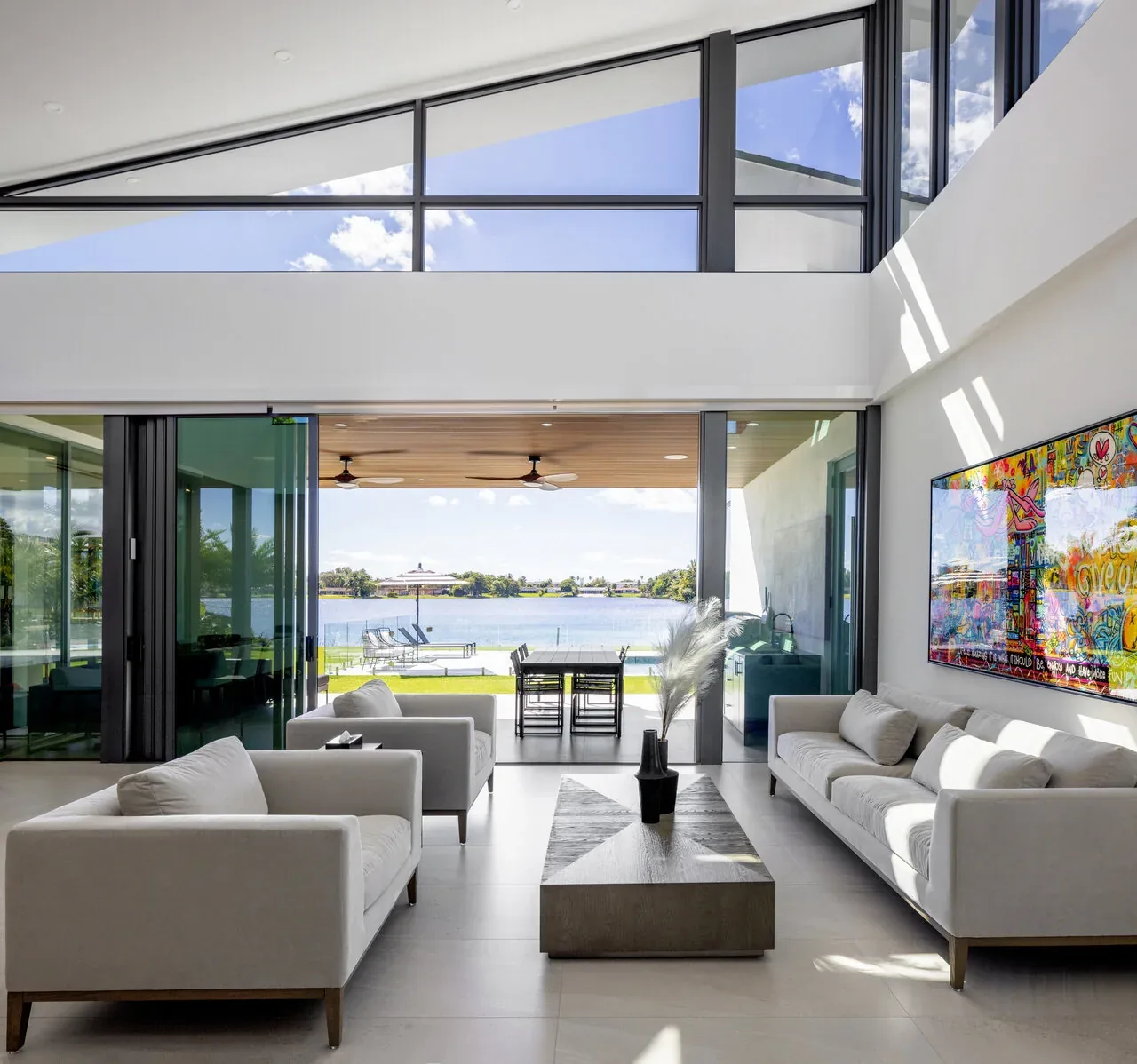
On a full renovation, windows belong in the same plan as stucco, drywall returns and interior finishes. On the Dania Beach house all windows and doors were replaced as part of the gut rehab, and on the Hollywood Lake House the windows and a glass wall to the water were part of taking the house back to structure. Doing it alongside the rest of the work avoids paying twice for patching and paint. Large sliders, glass walls and openings in older block with damaged bucks are the difficult part of window work, and that is where we do our best work. For new construction like the Sky Lake House, the impact glazing is designed into the structure from the start.
A real number for your house depends on the count, sizes and design pressures of your openings, and what the walls look like behind the old frames. That needs a site visit. If windows are part of a larger project, see our home renovation page.
Frequently asked questions
How much does it cost to replace all windows with impact windows in Miami?
For a typical single-family home with 15 to 20 openings, 2026 South Florida price guides commonly put the total between about $20,000 and $35,000 installed. Large homes with wide sliders, custom sizes or premium glass are priced from their opening schedule. The final number depends on opening sizes, design pressures, frame material and the condition of the walls.
What is a Miami-Dade NOA?
A Notice of Acceptance is Miami-Dade County’s product approval document. It confirms that a specific window, door or shutter passed the county’s impact and pressure tests, and its drawings set the allowed sizes, pressures and installation method. In Miami-Dade and Broward, which form the High Velocity Hurricane Zone, impact products must meet these protocols.
Do I need a permit to replace windows in Florida?
In Miami-Dade and Broward, yes. Replacing windows and exterior doors requires a building permit, with product approvals and a schedule of openings, followed by inspection. Fees and requirements vary by city. Unpermitted windows can cause problems with insurance mitigation credits, claims and resale.
Will impact windows lower my homeowners insurance?
Usually, if documented. Florida law requires insurers to offer credits for windstorm mitigation features including opening protection. You need a wind mitigation inspection on the current state form, revised in April 2026, submitted to your insurer. The size of the discount varies by insurer and by your roof and other features, so ask your agent for the figure.
Is the My Safe Florida Home grant still available in 2026?
As of 2026 the program is operating, offering free inspections and grants of up to $10,000 for eligible improvements, funded by money left over from the previous year. Eligibility rules have changed repeatedly, including a 2026 revision, and intake for inspections and grants has paused and reopened at different times, so confirm current terms on mysafeflhome.com before planning around a grant.
Are impact windows worth it compared to shutters?
Shutters cost less up front, but someone has to install them before every storm, and they block light while up. Impact windows protect the house when nobody is home, add security and noise reduction, and are generally expected by buyers in South Florida. For a home you plan to keep, windows are usually the better long-term value.