The Miami renovation trends worth following in 2026 are the ones that answer the climate and how people live: indoor-outdoor living with impact-rated glass, warm natural materials in place of gray, kitchens that hide their working parts, resilience built into the house, large-format slabs, spa-like bathrooms and rooms with a defined job. Some will last for decades. A few will date quickly, and it pays to know which is which.
Trends are worth paying attention to for one reason only: some of them are genuinely better ways to live in a house, and some are simply this decade’s version of something that will look dated the moment it stops being new. Here is what we are being asked for in South Florida this year, with an honest note on which is which and what each one really involves.
1. The indoor-outdoor line is disappearing
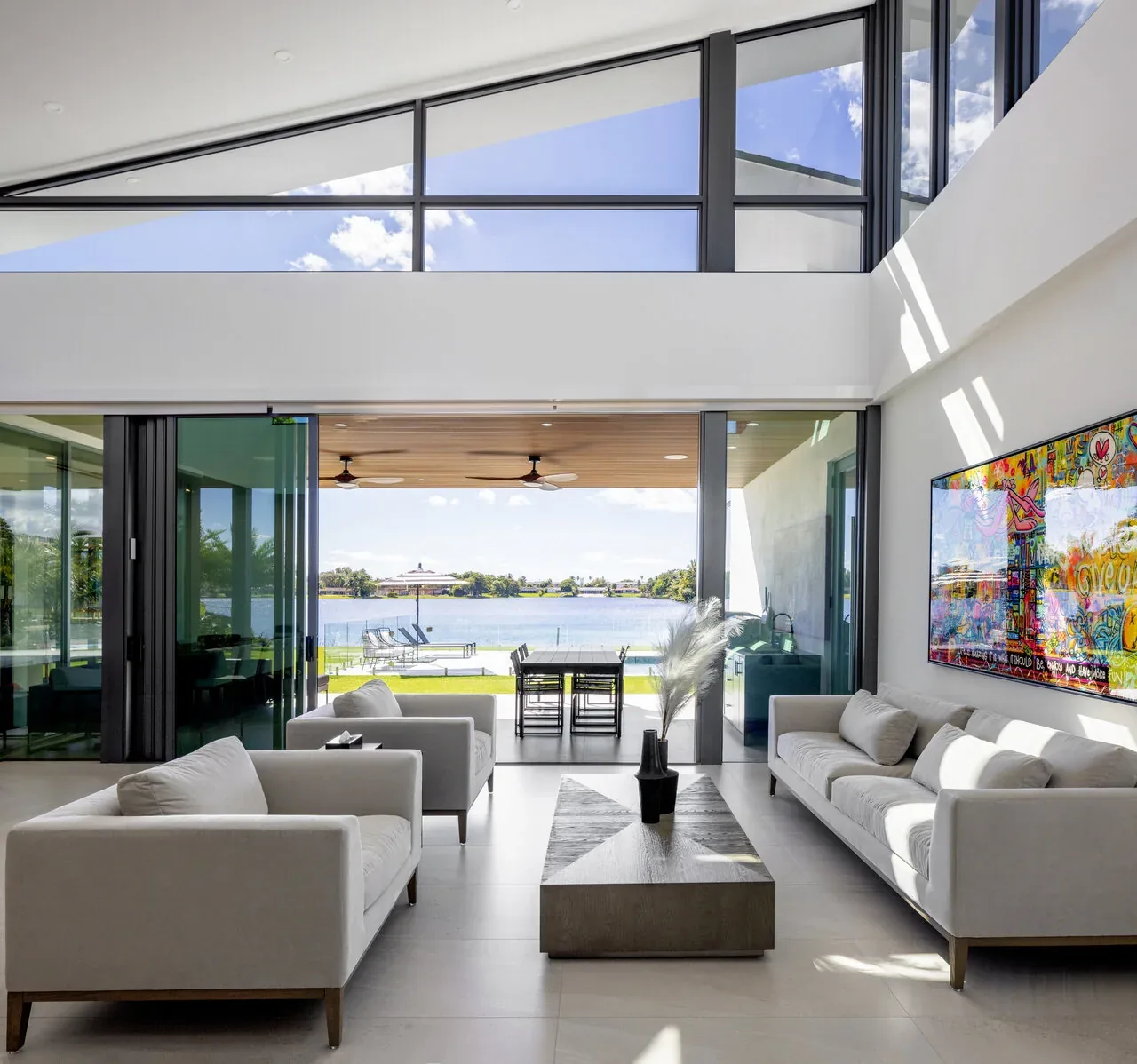
Large sliding and pocketing door systems that open a living area completely to a terrace or pool deck, with the interior floor running continuously through to the exterior with no threshold step.
This is the most climate-appropriate thing on this list. It is also structural. A wide opening needs a beam and a resolved load path, and in Miami-Dade and Broward, which sit in the Florida Building Code’s High-Velocity Hurricane Zone, the glazing must carry product approval for that zone. That makes these systems heavy and expensive. Worth it. Plan it early, because it is not something that can be added later.
A level threshold also needs thought about water. The exterior paving, drainage and door sill have to be detailed together so a summer downpour stays outside. Our Sky Lake House, largely glass with a pool terrace and dock, was designed around this idea from the foundation up.
2. Warm minimalism has replaced gray
The cool gray-and-white palette that dominated the last decade is over. What has replaced it is warmer and more tactile: oak and walnut tones, limewash and plaster wall finishes, travertine, bone and sand colors, brushed rather than polished metal.
It suits the light here far better than gray ever did. Gray reads flat in strong Florida sun; warm materials hold their depth. One practical caution: natural stone such as travertine and marble is more porous than porcelain, so it needs sealing and suits some rooms better than others. Our guide to the best flooring for Florida homes compares the options for humidity and sand.
3. Kitchens that hide the kitchen
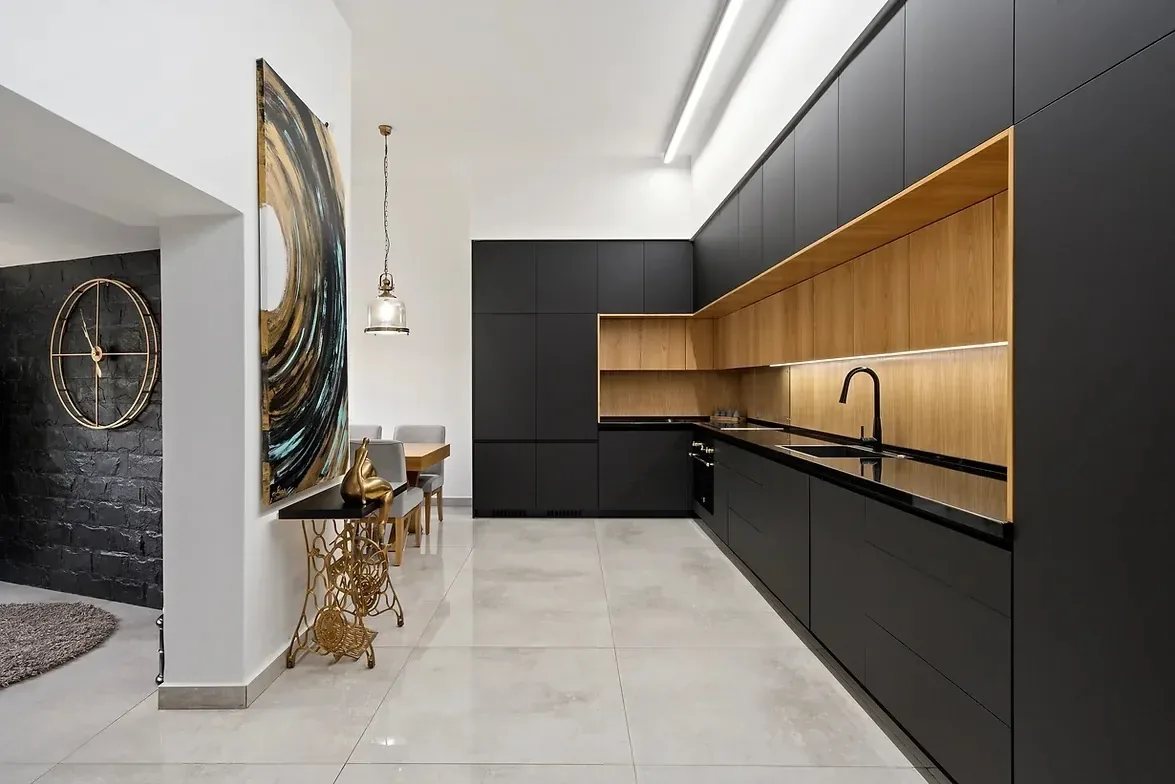
Integrated appliances behind cabinetry panels, tall units that conceal small appliances behind pocket doors, and increasingly a second prep kitchen or scullery where the actual mess happens.
The visible kitchen becomes part of the living space rather than a utility room attached to it. In an open-plan home this is genuinely useful, not just aesthetic. It is what makes open plan livable. It is also where budgets climb: panel-ready appliances and custom millwork belong to the top tier of kitchen pricing, covered in kitchen remodel cost in Miami.
4. Resilience as a design decision
Impact glazing throughout rather than only where code requires it. Standby generators. Mechanical equipment raised off the ground. Materials chosen because they recover from water rather than because they resist it.
This is not a style trend. It is homeowners in a hurricane zone building for the climate they actually have, and it shows up in money as well as peace of mind. Florida law requires residential property insurers’ rate filings to include discounts or credits for wind-mitigation features such as opening protection and roof strength. And in 2025 Cost vs. Value data for the South Atlantic region, a backup generator recovered about 97% of its cost at resale, far more than most interior upgrades.
If you are planning this work, read the Florida Building Code for hurricane renovations and impact windows and doors cost before you set a budget.
5. Large-format stone and porcelain, minimal grout
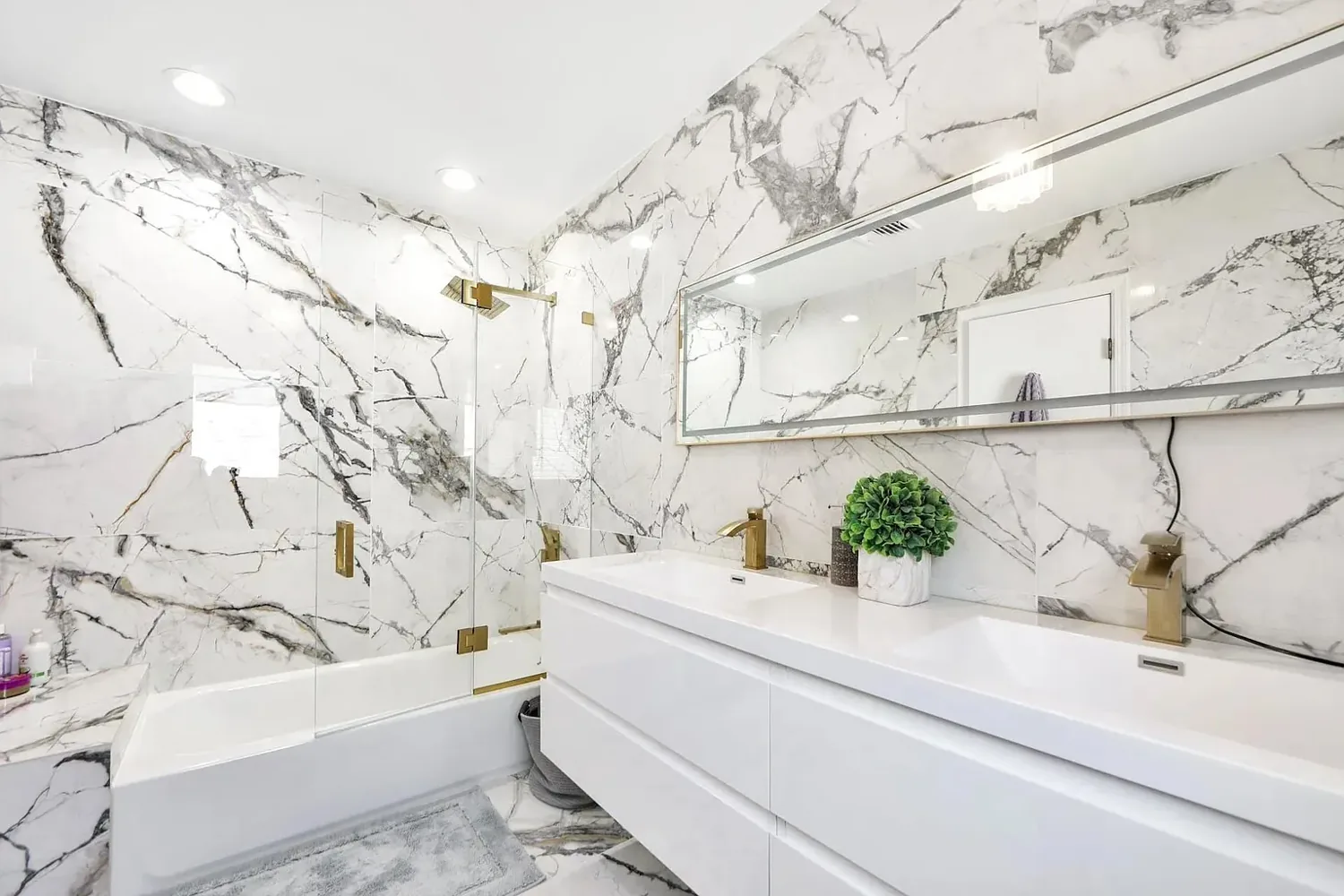
Slabs rather than tiles, on floors, on shower walls, and running up behind ranges as a continuous backsplash with the veining matched across the joint. Fewer lines, fewer grout joints, less to clean.
Beautiful and practical in this climate. Demands a very flat substrate and skilled setting; it is unforgiving of a poorly prepared slab. Miami cost guidance puts large-format porcelain or natural stone for floors and walls at roughly $20–40 per square foot, against about $10–20 for new standard tile in a mid-range remodel, and the flattening and handling add labor on top. Large-format work and matched veining are technically demanding, and they are where we do our best work. More detail is in large-format tile in bathrooms.
6. Bathrooms as a room, not a utility
Wet rooms where the shower and tub share a single waterproofed zone. Freestanding tubs. Concealed tanks and wall-hung fixtures so the floor runs uninterrupted. Layered lighting rather than one bright ceiling fixture.
The wet-room approach in particular is an argument for getting the waterproofing right, because the entire zone is now relying on it rather than a single enclosure. On our Hollywood Lake House all four bathrooms were rebuilt with waterproofing from the substrate up, which is the only way we would do it. Curbless showers also double as a sensible long-term choice; see curbless showers for aging in place.
7. Rooms with a defined job
The reaction against pure open-plan. Not a return to small closed rooms, but the reintroduction of a study, a media room, or a guest suite that can be genuinely closed off, usually with glazed doors so light still travels.
Several years of remote and hybrid working made a house with nowhere quiet to sit an obvious problem. In practice this often means adding a wall rather than removing one, which is far simpler structurally, or converting an underused formal dining room.
8. Condo owners renovating for the building, not just the unit
In the towers of Aventura, Sunny Isles Beach, Bal Harbour, Surfside, Miami Beach and Hallandale Beach, more owners are planning renovations around what their building requires: acoustic underlayment that meets the association’s sound rules, plumbing changes coordinated with shared risers, and timing that fits around building-wide structural work.
This is less glamorous than a waterfall island and more important. A beautiful floor that fails the building’s sound requirement has to come up. Start with condo soundproof flooring and what milestone inspections mean for owners, then see how we run condo renovations.
What these trends cost, roughly
| Trend | Industry cost reference |
|---|---|
| Backup power generator | About $13,600 job cost, South Atlantic 2025 |
| Large-format porcelain or stone | About $20–40 per sq ft (Miami) |
| Mid-range quartz or granite countertops | About $65–120 per sq ft (Miami); designer slabs priced after selection |
| Mid-range appliance package | About $7,000–18,000 (Miami); pro-grade priced by model |
| Midrange major kitchen remodel | About $83,500, Miami 2025 |
| Midrange bath remodel | About $25,600, Miami 2025 |
These are market references, not quotes. Large openings, impact glass and anything structural depend entirely on the house, and need a site visit to price.
What will date, and what will not
Likely to last: indoor-outdoor connection, natural materials, resilient construction, layered lighting, defined-use rooms. These are responses to climate and how people actually live.
Likely to date: whatever the current single fashionable color is, heavily patterned feature tile, and any fitted millwork designed around a specific appliance or device.
The reliable rule: spend on the things that are difficult to change (layout, structure, glazing, floors) and stay conservative there. Take your risks on the things that are easy to change later: paint, hardware, lighting fixtures, and anything that is not built in.
Mistakes we see when people follow trends
- Choosing a wide glass opening late, after the structure and budget are set.
- Putting soft natural stone in a high-traffic, sandy entry because it looked good in a photo.
- Specifying large-format slabs without budgeting for floor flattening.
- Building a wet room on ordinary waterproofing.
- Ignoring the condo’s flooring and plumbing rules until the board rejects the package.
What to ask your contractor
- Which of these choices need engineering, permits or product approvals?
- How will a level indoor-outdoor threshold handle heavy rain?
- What substrate preparation does this tile or slab need, and is it priced?
- What does my condo association require for flooring and plumbing?
- Which of these features could affect my insurance or resale?
To see how these ideas look finished, browse our portfolio or the kitchen gallery.
Frequently asked questions
What are the biggest home renovation trends in Miami for 2026?
The requests we see most are indoor-outdoor living with large impact-rated doors, warm natural materials replacing gray, kitchens with integrated appliances and hidden prep areas, hurricane resilience such as impact glass and generators, large-format slabs with minimal grout, spa-style bathrooms, and rooms with a defined use like a study or media room.
Is gray still in style for Miami homes?
Mostly not. The cool gray-and-white palette has given way to warmer tones: oak and walnut, limewash and plaster finishes, travertine, and sand or bone colors with brushed metal. Warm materials also suit strong Florida light better, since gray tends to look flat in bright sun. Keep bold color to things that are easy to change.
Do impact windows lower insurance in Florida?
They can. Florida law requires residential property insurers’ rate filings to include discounts, credits or other rate differentials for wind-mitigation features, including opening protection such as impact-rated windows and doors. The size of the discount depends on the insurer and the home’s other features, so ask your agent and get a wind-mitigation inspection after the work is complete.
Which renovation trends add the most value in South Florida?
Features that answer the climate tend to hold value best. In 2025 Cost vs. Value data for the South Atlantic region, a backup generator recovered about 97% of its cost and a midrange minor kitchen remodel about 109%, while upscale kitchen and bath remodels recovered far less. Spend on structure and resilience; be conservative with fashion.
Are large-format tiles a good idea in Florida?
Yes, in most rooms. They suit the climate, reduce grout lines and are easy to clean. They do need a very flat substrate and experienced setting, because large panels show every high or low spot and can crack if poorly supported. Budget for floor preparation, and choose porcelain where water and sand are constant.