Building a custom home in South Florida typically costs about $300 to $450 per square foot for construction. Production-level construction can come in around $225–275 per square foot, but that is not what most people mean by a custom home. Waterfront and architecturally complex homes are priced individually after design and engineering. Land, design, permits, impact fees and site work are on top, and on a waterfront lot they can add up to a significant share of the budget.
National and statewide figures you will find online are much lower. Those numbers are averages across tract housing on dry inland lots. A glass-heavy house on the water in Miami-Dade or Broward is built to different wind loads, often on a different foundation, with impact glazing that can be the largest line item in the project.
How much does it cost to build a custom home in South Florida per square foot?
The ranges below are typical market ranges for hard construction costs, cross-checked across current local, statewide and national data. They exclude land, and they are not a quote.
| Level | What it usually means | Typical range per sq ft |
|---|---|---|
| Production or spec | Standard plan, concrete block, standard impact windows, builder-grade finishes | $225–275 |
| Custom | Architect-designed, premium finishes, more glass, upgraded systems | $300–450 |
| Luxury or waterfront | Complex engineering, large-span glass, pool and dock, imported materials, automation | Priced individually after design |
On top of hard costs, plan on roughly 10–15% for soft costs: architecture, structural and civil engineering, surveys, soil testing, permits and impact fees. For scale, on a 3,000-square-foot house every $50 per square foot is $150,000, which is why the design brief and the lot should set the budget before drawings start.
What makes South Florida more expensive to build in
Wind design and the High-Velocity Hurricane Zone
Miami-Dade and Broward are the only two counties in the Florida Building Code’s High-Velocity Hurricane Zone. Inside it, windows, doors, roofing and other envelope products must carry approval for use in the zone, and the structure is engineered for higher wind and impact loads: reinforced block or concrete walls, tie beams, strapped or anchored roof framing, and connections designed for uplift.
Palm Beach County, including Boca Raton, is outside the HVHZ. Building there still requires hurricane-resistant design under the Florida Building Code, but the product approval path and some requirements differ. Our article on the Florida Building Code and hurricane design explains what that means in practice.
Impact glazing
Modern South Florida houses are glass houses. Floor-to-ceiling sliding doors, corner windows and walls of glass facing the water are what people want, and every square foot of it has to be impact-rated and installed to its tested approval. On a glass-heavy design, windows and doors can be the largest single swing in the budget, and large-span units often have long lead times. See impact windows and doors cost in Florida.
Flood elevation and the foundation
If the lot is in a FEMA special flood hazard area, the Florida Building Code requires the lowest floor in most A zones to be at or above the base flood elevation plus one foot, or the design flood elevation if higher. Coastal A and V zones, where waves are a factor, have stricter rules. Some cities add their own minimums, for example relative to the crown of the road.
In practice this decides the foundation: a raised slab with fill, stem walls, or a pile foundation where soils or flood zone require it. Below the flood level, materials must be flood-resistant and enclosed areas need flood openings. On a low waterfront lot, the foundation and fill alone can move the budget by tens of thousands of dollars or more, and elevating the house also affects stairs, driveways, pool decks and how the house meets the yard.
Site work
Many custom builds in established neighborhoods start with an existing house that has to be demolished. Then come the survey, soil borings, possibly dewatering for foundations near the water table, utility connections and, on waterfront lots, seawall, dock and environmental permitting, which are separate projects with their own approvals and timelines.
National data puts a typical foundation at $25,000–70,000, and site preparation varies widely with conditions. On a waterfront South Florida lot, plan toward the upper end of both.
Impact fees
New homes pay impact fees before the building permit is issued. As of 2026, Miami-Dade’s published schedule charges a countywide mobility (road) fee of roughly $9,300–10,600 per new single-family house depending on location, plus school, fire, police and park fees that vary by municipality. Broward collects its own school impact fees, and cities set some fees of their own. These are not optional and should be in your budget from day one.
Waterfront: what changes
A waterfront lot is the most expensive place to build and the most rewarding. It typically brings:
- A flood zone, often with a higher required floor elevation.
- More glass, and larger panels, facing the water.
- A pool and terrace designed together with the house rather than added later.
- A dock and possibly seawall work, each with its own permits.
- Glass railings or fences that keep the view open toward the water.
- Salt exposure, which affects metal selection, fasteners and finishes.
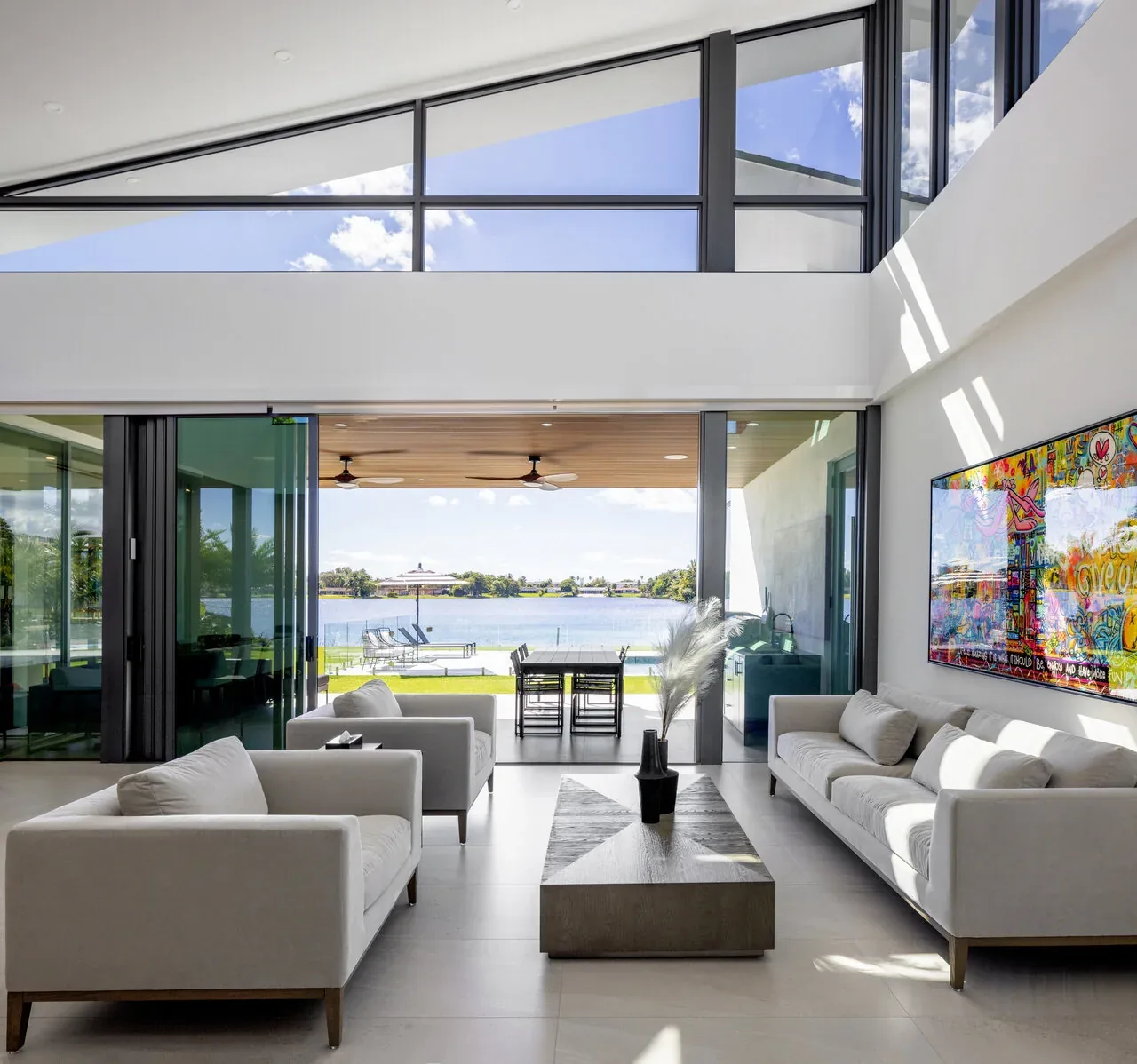
Our Sky Lake House is an example: ground-up construction on a waterfront lot in the Sky Lake neighborhood of north Miami-Dade, largely glass with impact glazing, a pool terrace, a glass fence, a dock and a continuous wood soffit. It took about twelve months of construction. Every one of those features is a line item that a per-square-foot average does not capture. Large-span glass, flood-driven foundations and structural spans are the difficult parts of a build like this, and they are where we do our best work.
What else moves the number
- Structural spans. Cantilevers, column-free living rooms and flat roofs with deep overhangs need more concrete, steel and engineering.
- Roof type. Flat concrete roofs, standing-seam metal and tile all price differently and carry different approvals.
- Finish level. Custom millwork, slab stone and architectural lighting can move the budget substantially without changing the size of the house.
- Systems. Whole-house generators, automation, multi-zone air conditioning and pool equipment add up.
- Contract structure. Fixed-price and cost-plus contracts allocate risk differently. See fixed price vs cost-plus contracts.
- Who builds it. Florida allows owner-builder permits in limited cases, but the risk sits with you. Read owner-builder permits in Florida first.
Build new or renovate?
If you already own a house on a good lot, the question is whether to renovate or rebuild. A house that sits well below today’s required flood elevation, or a renovation that would cross the FEMA 50% threshold, often points toward rebuilding. A sound structure above the flood level usually points toward renovation. We compare the two in whole-home renovation cost in South Florida, and the flood rule in the FEMA 50% rule.
How to budget a custom home
- Start with the lot: survey, flood zone, base flood elevation, soil conditions, setbacks and any seawall or dock issues.
- Set a construction budget per square foot that matches the design ambition, not the other way around.
- Add soft costs and impact fees as separate lines.
- Price glass, foundation and site work early. They swing the most.
- Hold a contingency of at least 10%.
Our new construction page explains how we run ground-up projects, and the portfolio shows the work. A real number starts with the lot and a design direction. We are happy to walk the site with you, look at the survey and the flood zone, and tell you plainly what the land will ask of the budget.
Frequently asked questions
How much does it cost to build a house in Miami per square foot?
Typical hard construction costs run about $225–275 per square foot for production-level homes and $300–450 for custom homes. Luxury and waterfront builds are priced individually after design. Add roughly 10–15% for design, engineering, permits and impact fees. Land is separate. Online figures below $200 per square foot usually describe basic tract housing.
How long does it take to build a custom home in South Florida?
Design and permitting commonly take many months before construction, longer in cities with heavy review. Construction time depends on size, foundation and how much custom glass and millwork is involved. Our Sky Lake House, a waterfront home, took about twelve months of construction. Long-lead items such as large impact glass and custom millwork need to be ordered early to hold the schedule.
Is it cheaper to buy or build in South Florida?
Building a custom home rarely beats buying an existing one on price alone, especially once land, soft costs and impact fees are included. Building makes sense when you want something the market does not offer, already own the lot, or own a house that would cost nearly as much to bring up to flood and wind requirements.
What is the High-Velocity Hurricane Zone?
It is a part of the Florida Building Code that applies only in Miami-Dade and Broward counties. Inside it, windows, doors, roofing and other envelope products must be approved for use in the zone, and buildings are engineered for higher wind and impact loads. Palm Beach County, including Boca Raton, is outside the HVHZ but still requires hurricane-resistant design.
How high does a new house have to be built in a flood zone?
In most FEMA A zones, the Florida Building Code requires the lowest floor to be at or above the base flood elevation plus one foot, or the design flood elevation if higher. Coastal A and V zones have stricter foundation rules. Some cities add their own minimums, so confirm the required elevation with the building department before design starts.
What impact fees apply to a new home in Miami-Dade?
Miami-Dade assesses mobility (road), school and fire fees, and police and park fees are typically collected by the municipality. As of 2026, the published schedule’s road fee alone is roughly $9,300–10,600 per new single-family house. Fees must be paid before the building permit is issued. Confirm the total with the county Impact Fee Section.